
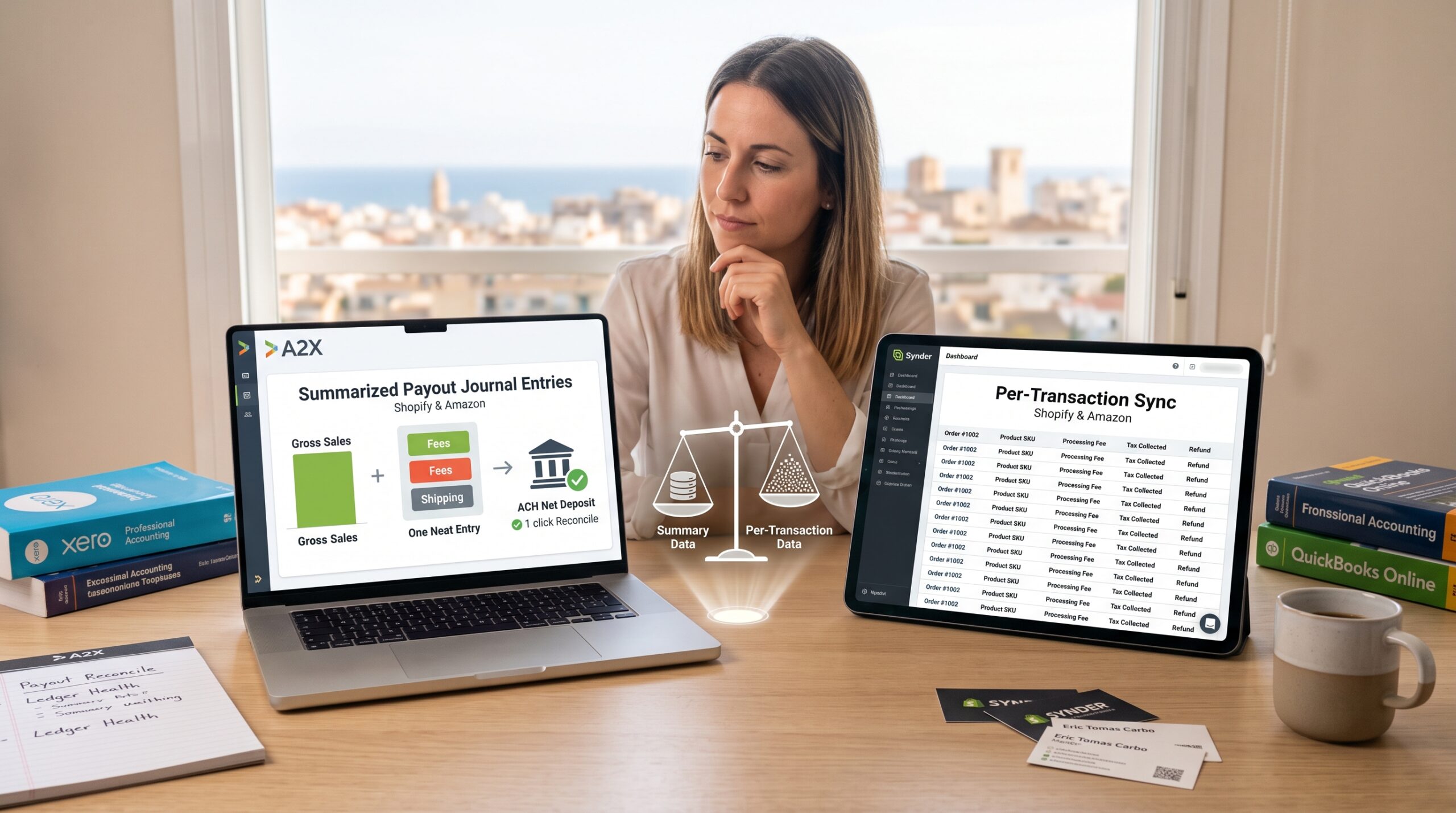
Reconciling your books as an e-commerce seller is fundamentally different from running a traditional service business. When Shopify or Amazon sends a payout to your bank account, they never deposit your gross sales.
Instead, you receive a single net deposit. A $10,000 sales week might arrive in your bank feed as an $8,650 deposit after the platform deducts payment processing fees, shipping labels, refunds, advertising costs, and sales tax.
If you connect Shopify or Amazon directly to your bookkeeping software without a dedicated connector, one of two disasters happens: either your bank feed never matches your gross revenue, or your general ledger gets clogged with thousands of individual micro-transactions that slow your software to a crawl.
In the e-commerce bookkeeping space, A2X and Synder are the two industry-standard tools designed to fix this problem. While both act as bridges between your sales channels and your general ledger, they handle your data using completely opposite philosophies.
(If you haven’t finalized your core accounting platform yet, review our breakdown of Xero vs QuickBooks Online before configuring your e-commerce connectors).
Quick Comparison: A2X vs Synder
| Feature / Metric | A2X | Synder |
| Starting Price | ~$29 / month (per channel) | ~$65 / month (covers multiple channels) |
| Syncing Method | Summarized journal entries per payout | Individual transaction sync (or daily summary) |
| Usage Metering | Based on completed orders | Based on synced transactions (sales + fees + refunds) |
| Bank Reconciliation | 1-click exact match to net bank deposit | Matched via intermediary clearing accounts |
| General Ledger Impact | Zero bloat (1 entry per settlement) | High ledger volume unless summary mode is on |
| Multi-Channel Coverage | Priced per sales channel (Shopify, Amazon, Etsy, etc.) | 30+ platforms supported in a single account |
| Supported Ledgers | QuickBooks Online, Xero, NetSuite, Sage | QuickBooks Online, Xero, QuickBooks Desktop |
| Best For | High-volume sellers & accrual bookkeeping | Multi-channel merchants needing per-order detail |
The Fundamental Difference: Payout Summaries vs Per-Transaction Sync
The choice between A2X and Synder comes down to a single architectural decision: How much detail belongs inside your general ledger?
A2X: The Summary Approach (The Accountant’s Choice)
A2X does not import every single $20 order into QuickBooks or Xero. Instead, it waits for Shopify, Amazon, eBay, or Walmart to close a payout settlement.
It reads all the underlying activity—gross sales, collected sales tax, shipping fees, returns, and merchant charges—and compresses them into one neat journal entry per payout. Because the bottom-line total of this entry matches the net deposit in your bank feed down to the exact penny, reconciling your books in QuickBooks or Xero requires just a single click.
Synder: The Transaction-Level Approach
Synder was originally designed to record every individual customer order, processing fee, and refund as its own distinct entry inside your ledger. It uses a virtual clearing account to collect these individual lines and match them against incoming bank transfers.
While Synder also offers a daily summary mode, its primary advantage is preserving granular, customer-level data and SKU details directly inside your accounting software.
Pricing Realities: Orders vs Synced Transactions
At first glance, A2X looks cheaper with a $29 entry tier compared to Synder’s $65 base plan. However, how each platform counts your usage dramatically impacts your actual monthly bill:
- A2X meters by orders per channel: If you sell 400 products on Shopify, A2X counts that as 400 orders. However, A2X charges per sales channel. If you sell on Shopify, Amazon, and Etsy simultaneously, you must pay for multiple channel connections (or upgrade to a multi-channel package starting around $89/month).
- Synder meters by total synced events: Synder includes 30+ integrations under one plan, but it counts every movement of money as a transaction. A single customer purchase that involves a product sale, a payment processing fee, and a later partial refund can consume 3 “synced transactions” from your monthly allowance.
Cost Example:
- If you run one high-volume Shopify store doing 1,500 orders a month: A2X ($79/mo) is cheaper, cleaner, and will not penalize you when processing fees generate extra transaction lines.
- If you run four smaller storefronts (Shopify, Amazon, Etsy, and eBay) doing 150 orders each: A2X would require multiple channel subscriptions, whereas Synder ($65 to $115/mo) can connect all four platforms under a single subscription.
Ledger Health and Software Speed
A major hidden risk in e-commerce bookkeeping is ledger bloat.
Platforms like QuickBooks Online are databases. If your store generates 3,000 orders every month, syncing each transaction individually pumps 36,000 sales receipts, customer records, and fee lines into your ledger every year. Within 18 to 24 months, running a standard Profit & Loss report can become painfully slow.
- A2X prevents ledger bloat entirely. By posting only 2 to 4 summarized entries per month per channel, your ledger stays fast and responsive regardless of whether you process 500 or 50,000 orders.
- Synder requires careful configuration. If you process high transaction volumes, you must turn on Synder’s daily summary feature to prevent your general ledger from choking on micro-data.
If your store also processes independent contractor payouts or wholesale vendor bills, pair your ledger with dedicated accounts payable tools like those in our BILL vs Melio comparison to keep operational overhead organized.
Payment Gateway Handling (Stripe, PayPal, Shop Pay)
Modern checkout carts route funds through multiple third-party payment rails. A customer might pay through standard credit cards, PayPal, or buy-now-pay-later installments like Shop Pay.
- A2X automatically separates orders based on how they were funded. It holds payout data until the specific payment gateway deposits the funds, eliminating timing discrepancies where sales happen in late September but cash hits your bank account in October.
- Synder offers deep native integration with standalone payment gateways like Stripe and Square. If your business model includes a mix of online checkout carts and in-person card payments, review our Stripe vs Square comparison to see how transaction fees are calculated.
Final Verdict: Which Software Should You Choose?
- Choose A2X if your primary goal is clean, accurate books that reconcile to your bank deposits in seconds. It is the gold standard for accrual-basis accounting, preferred by professional e-commerce bookkeepers, and keeps your ledger lightweight.
- Choose Synder if you operate across several different niche platforms under modest order volumes, need custom “Smart Rules” to route products to specific income categories, or need individual customer names and order records saved directly inside your accounting software.
Related Reviews & Guides
- Xero vs QuickBooks Online: How the leading cloud accounting platforms handle e-commerce bank feeds.
- Stripe vs Square: Comparing payment processors for online checkouts and POS hardware.
- BILL vs Melio: The best ways to manage inventory supplier invoices and vendor bills.
- QuickBooks Online Simple Start vs Essentials: Choosing the right tier for multi-currency and accounts payable tracking.